Atonement · Redemption
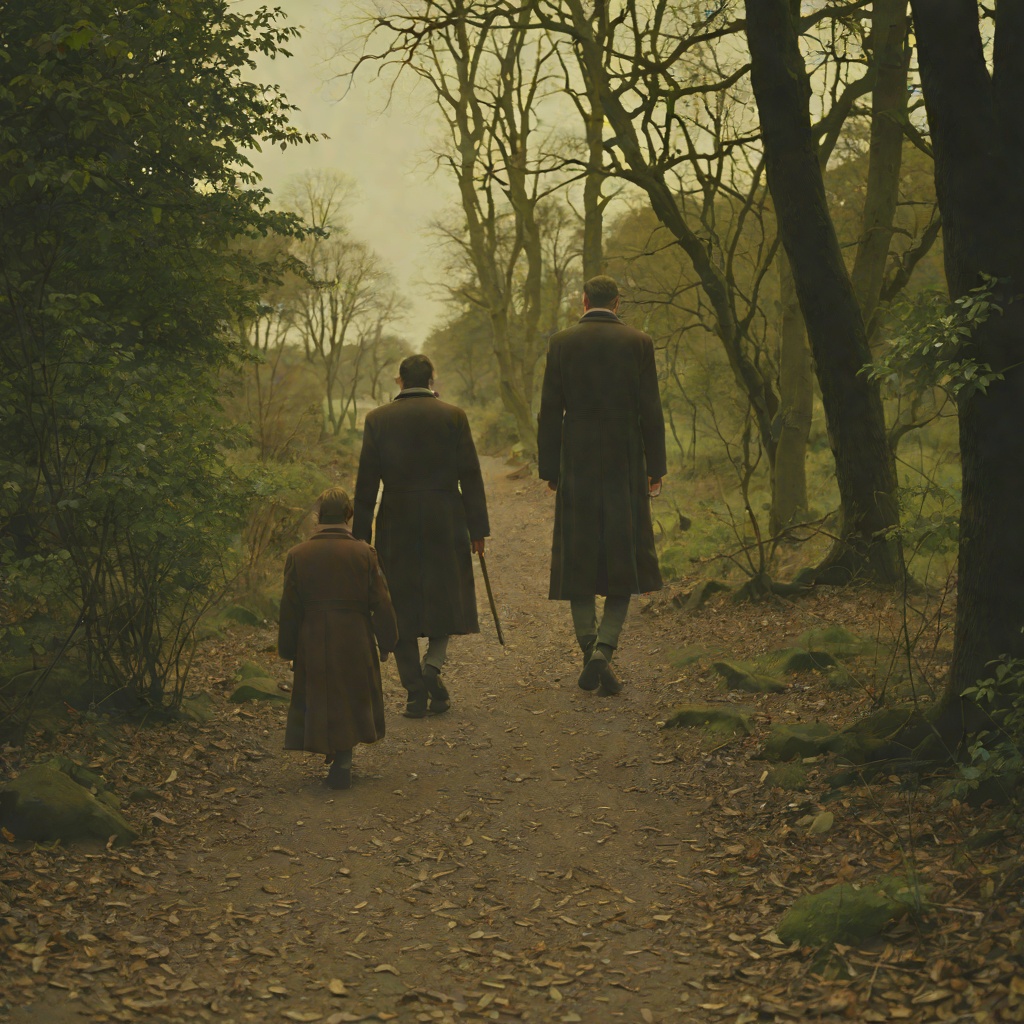
The Unlikely Pilgrimage of Harold FryAtonement and redemption form the moral core of the novel, the force that turns a retired man's impulsive decision to post a letter into a six-hundred-mile pilgrimage. The concept is not framed through religious doctrine but through the secular, physical act of walking: Harold Fry's journey to Berwick-upon-Tweed becomes a way of confronting a past he has spent twenty years avoiding, of accepting the strangeness of others, and of seeking forgiveness for specific sins of silence, cowardice, and letting others take the blame. The walk transforms atonement from an abstract spiritual idea into a lived, bodily practice, one that reaches its climax in Harold's confession letter to the garage girl and his final meeting with Queenie Hennessy at St Bernadine's Hospice.
The Call to Atonement
The concept is first ignited in the novel's opening movement, when Harold, having received Queenie Hennessy's letter, tells his wife Maureen that posting a reply is not enough. 'Please. I need to do this, Maureen,' he appeals, his voice 'stripped away' as he insists that he must walk. The decision is framed as a compulsion rather than a choice, and Maureen's response — 'Well, you head off to Berwick, Harold. If that's what you want. I'd like to see you get past Dartmoor' — only sharpens the stakes. The atonement is rooted in a specific, unspoken debt: Harold walks not because of a romance with Queenie, as people later assume, but because 'she saved me, and I never said thank you.' This admission, which he writes to the garage girl, reveals that the pilgrimage is an act of gratitude and reparation for a failure of acknowledgment that has haunted him for two decades.
The walk itself becomes the mechanism of atonement. Early in his journey, Harold reflects that 'in walking to atone for the mistakes he had made, it was also his journey to accept the strangeness of others.' This insight, prompted by his encounter with a silver-haired gentleman who confesses to licking his partner's trainers, marks a crucial expansion of the concept: atonement is not merely personal but relational, requiring Harold to carry 'a little of them as he went.' He understands that he has 'neglected so many things' and owes 'this small piece of generosity to Queenie and the past.' The act of listening to strangers becomes as central to his redemption as the walking itself.
The Weight of the Past
Atonement in the novel is inseparable from memory, and Harold's walk unleashes the past he has spent twenty years seeking to avoid. As he walks, he 'no longer saw distance in terms of miles. He measured it with his remembering.' The landscape triggers a cascade of recollections: Maureen digging in the front garden of Fossebridge Road, the fragility of David's head when he was born, the hollow cackle of a crow that returns him to his teenage loneliness. The past 'chattered and played through his head with a wild energy that was its own,' and the act of walking becomes a form of exposure, forcing Harold to confront what he has repressed.
The most feared memory surfaces near Taunton, when Harold recalls 'an afternoon twenty years ago when it had all come to an end.' The memory is so overwhelming that he shouts 'No' at the rain and drives his feet against the paving stones 'with such fury he hadn't the breathing to keep up.' The physical collapse that follows — his calf exploding 'as if the skin-side of the muscle had been sliced open' — dramatizes the cost of atonement: the body itself rebels against the weight of what is being confronted. Redemption, the novel insists, is not a gentle process but a violent reckoning with the past.
The full scope of Harold's guilt is revealed in his confession letter to the garage girl. He writes that twenty years ago he buried his son, David, who hanged himself in the garden shed with rope tied to one of the hooks used for garden tools. Harold discovered the body and was 'too late.' The letter details his subsequent alcoholism — bottles kept in paper bags under his desk — and the night he dismantled the garden shed and then broke into the brewery, where he 'did something terrible.' Queenie knew it had to be him and took the blame, was fired on the spot, and disappeared. Harold let her go. 'I let her take the blame. But I gave up drinking.' This confession is the hinge of the novel's atonement: Harold's walk is an attempt to undo, or at least to acknowledge, the moral failure of letting Queenie suffer for his crime.
The Discipline of the Walk
Atonement in the novel is enacted through a rigorous physical discipline. Harold's early inspection of his feet in a hotel room — clasping his ankle, drawing it up, examining the toes 'soft and pale,' the 'possible blister on the way at the top of his heel' — establishes the body as the site of redemption. He is 'quietly proud' of his feet, and the ritual of inspection becomes a daily act of self-care that mirrors the larger project of self-reckoning. The walk demands that Harold remain true to the feeling that inspired him: he keeps to the roads, sticks to his yachting shoes despite their wear and tear, and carries no mobile phone or road map. 'He had a different map,' the novel explains, 'and that was the one in his mind, made up of all the people and places he had passed.'
The discipline extends to his interactions with others. Harold tells the story of Queenie and the garage girl to strangers and asks for help, but 'never took more than he needed, and gently refused lifts, or walking equipment, or extra packages of food.' He sleeps outside, washes in public lavatories and streams, and binds his blisters with duct tape. The compass given to him by Martina — her partner's brass compass — quivers northwards and he follows, walking 'by day or by night, as the mood took him; mile after mile after mile.' The repetition of the walking becomes a form of prayer, and Harold reaches a state of certainty: 'Queenie would live. He knew it.' The atonement is sustained by the faith that his walking has the power to keep her alive.
The Limits and Completion of Redemption
Yet the novel is careful to complicate the idea of redemption. Harold's faith is 'a fragile thing,' and his journey is marked by doubt and collapse. When he finally reaches St Bernadine's Hospice, the reality of Queenie's condition — her cancer and disfigurement — threatens to undo the meaning of his pilgrimage. The concept of atonement is tested against the intractable facts of illness and death, and Harold must confront the possibility that his walk cannot save her.
The completion of Harold's atonement comes not in a triumphant arrival but in a quiet exchange. When Maureen meets him in Darlington and asks for forgiveness, Harold speaks so softly that 'the words were part of the air': 'I'm the one who needs forgiveness.' This reversal — the wronged party asking for pardon, the guilty party claiming the greater need — captures the novel's understanding of redemption as mutual and ongoing rather than achieved. Harold's confession letter to the garage girl ends with an acknowledgment of his own inadequacy: 'I fear my courage has never matched yours.' The atonement is not a clean resolution but a humble, incomplete gesture, an offering of the full story in place of the silence that has defined his life.
The novel's epigraph, drawn from the pilgrim hymn, frames the walk as a sacred undertaking: 'Shall make him once relent / His first avowed intent / To be a pilgrim.' Harold's atonement is thus situated within a tradition of pilgrimage, but the novel redefines the pilgrim's goal. He is not seeking a holy site but a person, and the redemption he seeks is not absolution but acknowledgment — of Queenie's sacrifice, of David's death, of his own failures. The walk becomes a way of living with the past rather than escaping it, and the novel ultimately suggests that atonement is not a destination but a practice, one foot in front of the other, carried out in the company of strangers and the memory of the dead.